Tokenomics
LINEA is the token of Linea Mainnet, designed to grow and support Ethereum and Linea. You do not need it to use the network: gas is paid in ETH, and LINEA has no governance rights. Surplus network revenue is burned as ETH and LINEA.
LINEA has no allocation for insiders, investors, or team members. LINEA is distributed to users as a reward for using apps and protocols on the Linea network.
This page explains how LINEA is allocated and how it entered circulation. For help using the token, see the Linea support page.
The token's contract address on Linea Mainnet and Ethereum Mainnet is
0x1789e0043623282D5DCc7F213d703C6D8BAfBB04.
Allocation
LINEA had a genesis supply of 72,009,990,000. This is 1,000x the genesis supply of ETH on Ethereum, and is the maximum supply. Burns reduce circulating LINEA over time; they are executed on Ethereum L1. Track burn totals on the Dune dashboard or growthepie.
85% of the LINEA supply is allocated to the community and ecosystem, comprising the Ecosystem Fund, with 15% held long-term by Consensys.
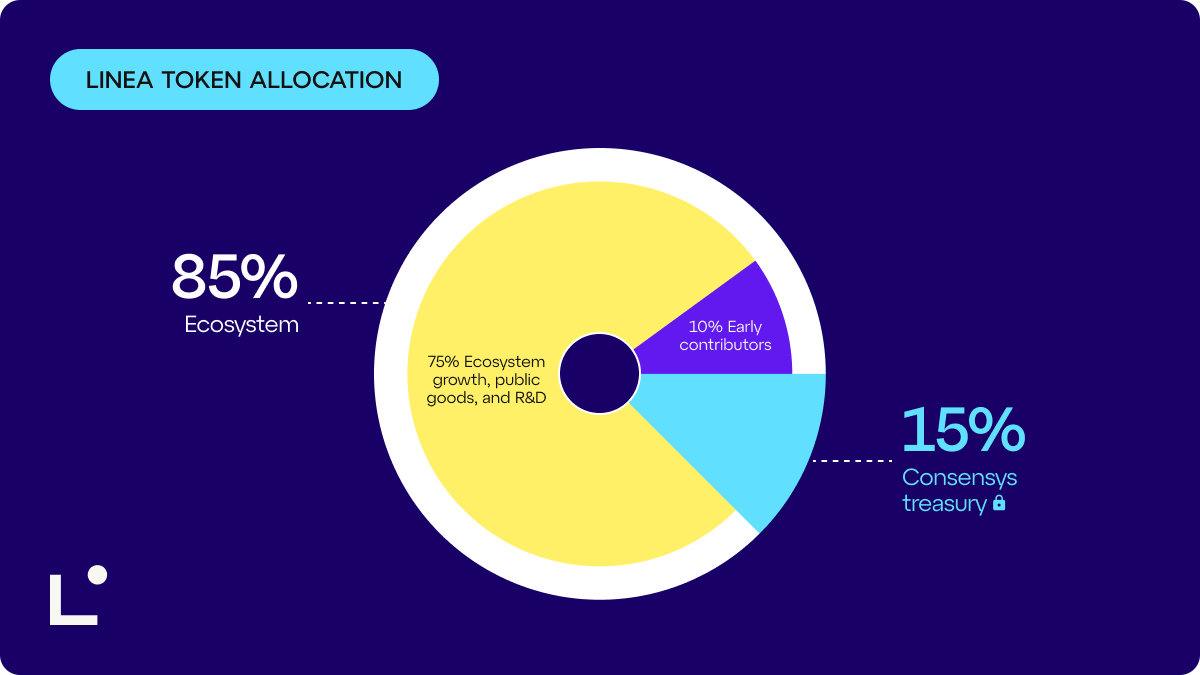
The supply is allocated according to the below table:
| Category | % of supply | Details |
|---|---|---|
| Ecosystem | 85% | 75% for a long-term Ecosystem Fund, and 10% for early contributors. |
| Consensys treasury | 15% | Locked (non-transferable) for five years. Consensys holds the tokens long-term for alignment and to support Linea and its ecosystem. |
Except for the initial allocation to Consensys, which is locked for five years, there is no allocation to private investors, insiders, or employees and team members. Instead, value is funneled straight into the ecosystem, the builders bringing it to fruition, and the community members engaging with it.
At the token generation event (TGE), 22% of the LINEA supply entered circulation, split between a user and builder airdrop, ecosystem activations, and liquidity provisioning (DEX liquidity).
All other allocations were locked at TGE, or vest (released over time) according to various schedules.
Ecosystem (85%)
Early contributors (10%)
The initial airdrop for early contributors comprised 10% of the supply:
- 9% to early contributors
- 1% to strategic builders
The user airdrop was based on onchain activity over the long term, including Linea Voyage XP (LXP). The 1% allocation for strategic builders is distributed through a curated, targeted process.
All tokens distributed through these airdrops are fully unlocked.
Ecosystem Fund (75%)
The long-term section of the Ecosystem Fund is managed by the Linea Consortium.
This 75% unlocks over 10 years, with unlocks weighted towards the earlier years to encourage early activation and adoption. Unlocks occur early; 10% per year in the early years, tapering to 2% by the tenth year.
These funds are used for:
- Funding for Ethereum R&D
- Maintaining shared ecosystem infrastructure such as audits, developer tools, and node infrastructure
- Funding public goods, such as open-source software, research, and community programs
- Strategic co-development with aligned organizations or emerging protocols
Consensys treasury (15%)
15% of the total token supply is held in the Consensys treasury. This allocation is locked for five years and is non-transferable until a vesting schedule is complete.
Burning mechanism
After covering infrastructure costs, 100% of surplus revenue gets burned:
- 20% of surplus revenue burned as ETH
- 80% of surplus revenue converted to LINEA and burned
How burning works on Linea
Linea and the LINEA token are designed specifically to reinforce the strength of Ethereum and ETH, achieved through an automatic, dual-burn mechanism.
As a result, network activity on Linea directly supports both the value of ETH and LINEA.
Every transaction on Linea generates gas fees paid in ETH. Instead of keeping these fees, Linea's burn mechanism permanently removes ETH and LINEA tokens from circulation. This creates deflationary pressure on both tokens, directly benefiting holders and the broader ecosystem.
This means Linea becomes a perpetual buyer of its own token while simultaneously reducing ETH supply.
Step 1: Revenue collection
All gas fees from transactions on Linea are paid in ETH and automatically collected into a revenue vault contract. This happens continuously as users interact with the network. Every swap, transfer, NFT mint, or smart contract interaction contributes to this pool.
Step 2: Covering infrastructure costs
Running a high-performance layer 2 network has real costs:
- Onchain costs: Submitting transaction data to Ethereum L1, finalizing proofs, bridge transactions (anchoring and claiming)
- Offchain costs: Running the mainnet infrastructure (servers, databases, monitoring systems)
Once calculated, an invoice is submitted to the revenue vault. The vault automatically pays what it can from available funds. If there's not enough balance, it tracks the outstanding amount (called "arrears") and pays it off when more revenue comes in.
Infrastructure costs are always paid first. Burns only happen when there's surplus revenue.
Step 3: The burn operation
Once costs are covered and there's surplus revenue available, the burn operation is triggered by a service operated by the Linea Consortium on a regular basis:
ETH burn (20%)
The vault takes 20% of the available surplus and sends it directly to the zero address
(0x0000000000000000000000000000000000000000).
This ETH is permanently removed from circulation; it can never be recovered or used again.
LINEA burn (80%)
The remaining 80% goes through a more complex process:
- Swap: The ETH is swapped for LINEA tokens using a decentralized exchange (DEX) on Linea. This creates buying pressure on LINEA and happens at the current market rate with slippage protection to prevent unfavorable trades.
- Bridge: The LINEA tokens are then bridged from Linea (L2) to Ethereum (L1) using Linea's native token bridge. They're sent to a special burner contract on L1.
- Burn: On Ethereum L1, the LINEA tokens are permanently burned. This is important because LINEA's total supply is tracked on L1, so burning must happen there to properly reduce the circulating supply.
The bridging and burning on L1 is designed to be permissionless: anyone can trigger the final burn step, ensuring the process can't be blocked or censored.
Step 4: Transparency
Every step of this process is recorded onchain:
- Invoice submissions with exact cost amounts and time periods
- Burn operations with precise amounts of ETH and LINEA destroyed
- Bridge transactions showing LINEA moving from L2 to L1
- Final burn transactions on Ethereum L1
You can verify everything yourself by checking the blockchain. The Dune dashboard and growthepie burn tracker make it easy to track:
- Total gas fees collected
- Total ETH burned since September 11, 2025
- Total LINEA burned since September 11, 2025
- Daily burn amounts for both tokens
- Historical trends and charts
Smart contract addresses
- L1LineaTokenBurner: 0x5Ad9369254F29b724d98F6ce98Cb7bAD729969F3 (L1)
- RollupRevenueVault: 0xFD5FB23e06e46347d8724486cDb681507592e237 (L2)
- V3DexSwapAdapter: 0x30A20a3a9991c939290f4329cb52daac8e97F353 (L2)